

 The Resurrection of our Lord Jesus Christ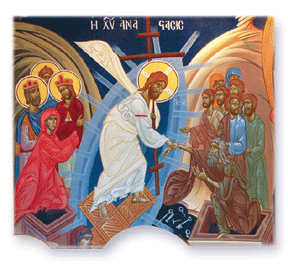
The miracle of the resurrection, described in the Bible, is the most important miracle of the Christian faith. When Jesus Christ rose from the dead on the first Pascha morning, he showed people that the hope he proclaimed in his Gospel message was real, and so was God's power at work in the world.
Mary Magdalene, and the other women who were present at the burial of our Savior on Friday evening, returned from Golgotha to the city and prepared fragrant spices and myrrh, so that they might anoint the body of Jesus. At early dawn on the Sunday that followed, almost thirty-six hours since the death of the Life-giving Redeemer, they came to the sepulcher with the spices to anoint His body. While they were considering the difficulty of rolling away the stone from the door of the sepulcher, there was a fearful earthquake; and an Angel, whose countenance shone like lightning and whose garment was white as snow, rolled away the stone and sat upon it. The guards that were there were terrified and took to flight.
The women, however, went into the sepulcher, but did not find the Lord's body. Instead, they saw two other Angels in the form of youths clothed in white, who told them that the Savior was risen, and they sent forth the women, who ran to proclaim to the disciples these gladsome tidings.
Then Peter and John arrived, having learned from Mary Magdalene what had happened, and when they entered the tomb, they found only the winding sheets. Therefore, they returned again to the city with joy, as heralds now of the supernatural Resurrection of Christ, Who in truth was seen alive by the disciples on this day on five occasions.
Our Lord, was crucified, died, and was buried on Friday, before the setting of the sun, which was the first of His "three days" in the grave; observing the mystical Sabbath, that "seventh day" in which it is said that the Lord "rested from all His works" (Gen. 2:2-3), He passed all of Saturday in the grave; and He arose "while it was yet dark, very early in the morning" on Sunday, the third day, which, according to the Hebrew reckoning, began after sunset on Saturday.
As we celebrate His joyous Resurrection, we greet and embrace one another in Christ, thereby demonstrating our Savior’s victory over death and corruption, and the destruction of our ancient enmity with God, and His reconciliation toward us, and our inheritance of life everlasting.
The feast itself is called Pascha, which is derived from the Hebrew word which means "Passover"; because Christ, Who suffered and arose, has made us to pass over from the curse of Adam and slavery to the devil and death unto our primal freedom and blessedness. In addition, this day of this particular week, which is the first of all the rest, is dedicated to the honor of the Lord; in honor and remembrance of the Resurrection, the Apostles transferred to this day the rest from labor that was formerly assigned to the Sabbath of the ancient Law.
Entrance of Our Lord to Jerusalem
On Sunday, five days before the Passover of the Law, the Lord came from Bethany to Jerusalem. Sending two of His disciples to bring Him a foal of an ass, He sat thereon and entered into the city. When the multitude there heard that Jesus was coming, they straightway took up the branches of palm trees in their hands, and went forth to meet Him. Others spread their garments on the ground, and yet others cut branches from the trees and strewed them in the way that Jesus was to pass; and all of them together, especially the children, went before and after Him, crying out: "Hosanna: Blessed is He that cometh in the Name of the Lord, the King of Israel" (John 12:13). This is the radiant and glorious festival of our Lord's entry into Jerusalem that we celebrate today.
The branches of the palm trees symbolize Christ's victory over the devil and death. The word Hosanna means "Save, I pray," or "Save, now." The foal of an ass, and Jesus' sitting thereon, and the fact that this animal was untamed and considered unclean according to the Law, signified the former uncleanness and wildness of the nations, and their subjection thereafter to the holy Law of the Gospel.